CFP – Ecstatic Truth X: Animating Hope

Ecstatic Truth X: Animating Hope: Utopias, Uncertainties, Simulation, and Documentary Possibility

In association with UNDER_the_RADAR Festival and University of Applied Arts, Vienna, we are calling for papers for our next symposium on April 27th and 28th, which will take place at the University for the Applied Arts in Vienna

Deadline for proposals is 14th Feb 2026
Submit proposals here via Oxford Abstracts: 
 https://tinyurl.com/3tm6dkc3.

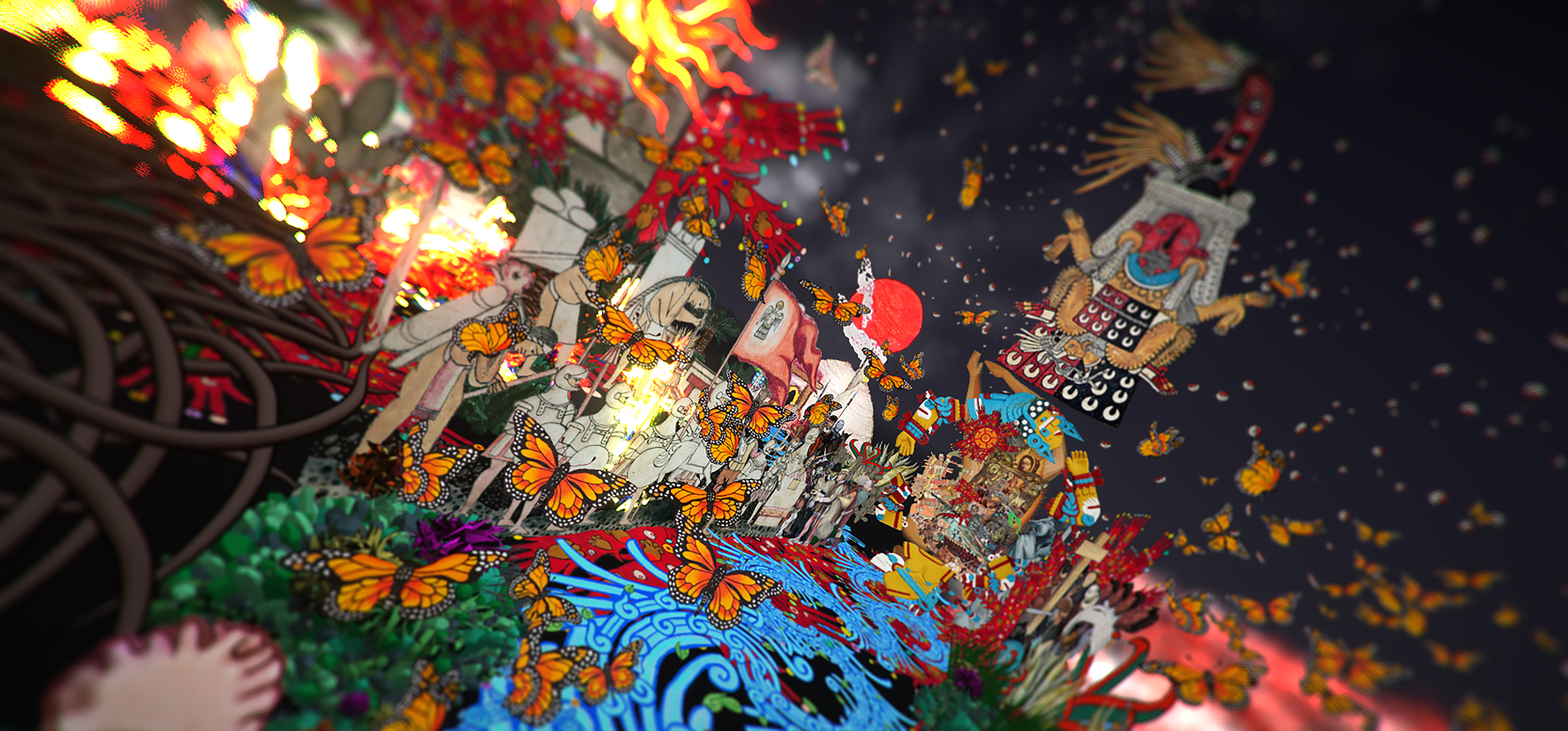
Image by Holger Lang


Ecstatic Truth is an annual symposium on themes arising from documentary animation as framed by Werner Herzog’s notion of a stratum of truth that exceeds the merely factual. In the 1999 Minnesota Declaration, Herzog contrasted the norm-making force of facts with an ‘ecstatic truth’, a deeper illumination, arguing that artifice can be a legitimate pathway to truth.

Documentary animation is uniquely positioned to operate in that register. By design it can render what live-action cannot—memories and dreams, internal states and dispersed timescales—expanding the range and depth of what documentary can show us about the world. In other words, animation openly declares its artifice while still aiming at the real, turning representational constraint into epistemic advantage. Our contemporary situation complicates this task. As Yuval Noah Harari observes, we live in a world ‘deluged by irrelevant information’ and where censorship often means flooding publics with distraction rather than blocking data outright. Animated Documentary’s contribution, then, could be to gain power through clarity, not to mimic the torrent but to compose it—to convert data into meaning, and information into felt knowledge.

Our tenth-anniversary theme – Animating Hope – treats hope, through Ernst Bloch’s perspective; not as naïve uplift but as a resistant orientation toward the “not-yet,” a wager that transformation remains possible even when the present seems unlivable. In this spirit, we welcome work that engages speculative traditions where imagining other worlds is itself a critical method, Afrofuturism reimagines and reclaims past and present through a Black cultural lens to prototype liberatory futures; queer futurity, following José Esteban Muñoz, directs attention to what could be, rather than only what is—treating the horizon of possibility as a guide for both practice and understanding. Alongside situated work from Serbia and Ukraine and Gaza-based initiatives such as Letters to Gaza and animator Haneen’s workshops, bringing hope to communities in practical ways. We also recognise emergent symbolic practices—such as the Gen Z protesters adoption of the One Piece Jolly Roger, as visual tactics of solidarity and hope.

Under the sign of ecstatic truth, we therefore invite practice-based, theoretical, and historical contributions that test how animated documentary can make hope operational—stylistically, ethically, and politically. What techniques (abstraction, rotoscope, collage, data-driven or hand-drawn worlds) help transmute ‘information’ into clarity without forfeiting complexity? How might artists signal invention while safeguarding participants and contexts? In what ways do speculative prototypes—challenges to the rule of AI and technological presets—and the situated practices above—function as forms of research, resistance, and survival? And above all: how can documentary animation shine “hope in the darkest places,” converting the seen and the unseeable into the kind of truth that moves us to act?

References: 

Harari, Yuval Noah. (2018). 21 Lessons for the 21st Century. Spiegel & Grau
Bloch, Ernst. (1995). The Principle of Hope. Cambridge, Mass. :MIT Press,


Themes

We invite practitioners and theorists working in non-fictional animation to consider the following questions:

Animating Hope: Utopias, Resistance, and Futures

  • How can animation embody hope as a form of resistance in times of political, social, or ecological crisis?
  • Is hope enough, or how might it be leveraged against overwhelming powers? (cf. Tolkien’s notion of fighting even when the ‘dragon’ is stronger).
  • What lessons can be drawn from past moments of collective hope, such as 1968, for today’s political and artistic futures?
  • How do Afrofuturism, queer futurity, and speculative practices (e.g., Octavia Butler, José Esteban Muñoz) expand the documentary imagination?

Methods, Media, and Resistance

  • What new methodologies can artists and scholars develop in the age of global capitalism to imagine and document alternative futures?
  • How might animation serve as a counter to despair, protest fatigue, and media-political control?
  • In what ways does the act of creating art itself constitute a conscious form of resistance?

Hope, Politics, and the Public Sphere

  • How does hope function as dialogue, as an antidote to blame culture, and as a means of standing against state or corporate control?
  • What role do economic structures play in shaping, restricting, or enabling documentary animation as a resistant practice?
  • How can language and translation (e.g., English as a dominant mode) shape or constrain documentary storytelling?

Technology, AI, and Documentary Uncertainty

  • How do deepfakes, AI, and algorithmic media complicate questions of authenticity, indexicality, and truth in documentary animation?
  • Can AI meaningfully contribute to documentary practices, or does it collapse difference and risk reducing meaning-making to economic pressures?
  • How do we negotiate between the personal, affective touch of human-made documentary and the commercial, automated logics of AI?

Ecstatic Truth in Dark Times

  • How can documentary animation shine “hope in the darkest places” (John Berger)?
  • What does it mean to create ecstatic truth in the face of apocalypse, collapse, or uncertainty?
  • How might acts of celebration, gathering, or even “partying in the face of the apocalypse” offer alternative modes of resistance, memory, or testimony?

Submission Details

We call for papers, presentations and responses on our themes of animating hope, in all its different manifestations, in relation to non-fiction manipulated moving image and animated documentary, in their most expanded forms. 

Submission is via Oxford Abstracts at this link: https://tinyurl.com/3tm6dkc3. You will be prompted to create a free account with Oxford Abstracts.

Your submission should include:

  • Title of your presentation
  • Abstract Please enter a brief summary of your proposed presentation with at least 2-3 references (max 500 words including bibliographic references)
  • Biography – a short bio of max 200 words, including relevant links to moving image work/websites etc.

If the paper is practice-based, it should include reflection and contextualisation in addition to presenting the practice. We will not accept papers that propose to show the practice only.

Finally, we are unable to provide feedback on individual submissions.


About Ecstatic Truth

Ecstatic Truth is an annual symposium on animated documentary founded in 2016 that explores issues arising from the interface between notions of animation and of documentary (conceptualised very broadly as non-fiction), with a particular interest in questions raised by experimental and practitioner perspectives. 

This year, we are in collaboration with UNDER_the_RADAR Festival and University of Applied Arts, Vienna and are open to proposals for future collaboration with other organisations.

Contact: ecstatic.truth.symposium{at}gmail.com

Ecstatic Truth collective: 

Birgitta Hosea, Animation Research Centre, University for the Creative Arts, Farnham;
Pedro Serrazina, Universidade Lusófona, Lisboa; 
Tereza Stehliková, University of Creative Communication (VŠKK), Prague; 
Natalie Woolf,  Universidade Lusófona, Lisboa.

Ecstatic Truth is supported by: 

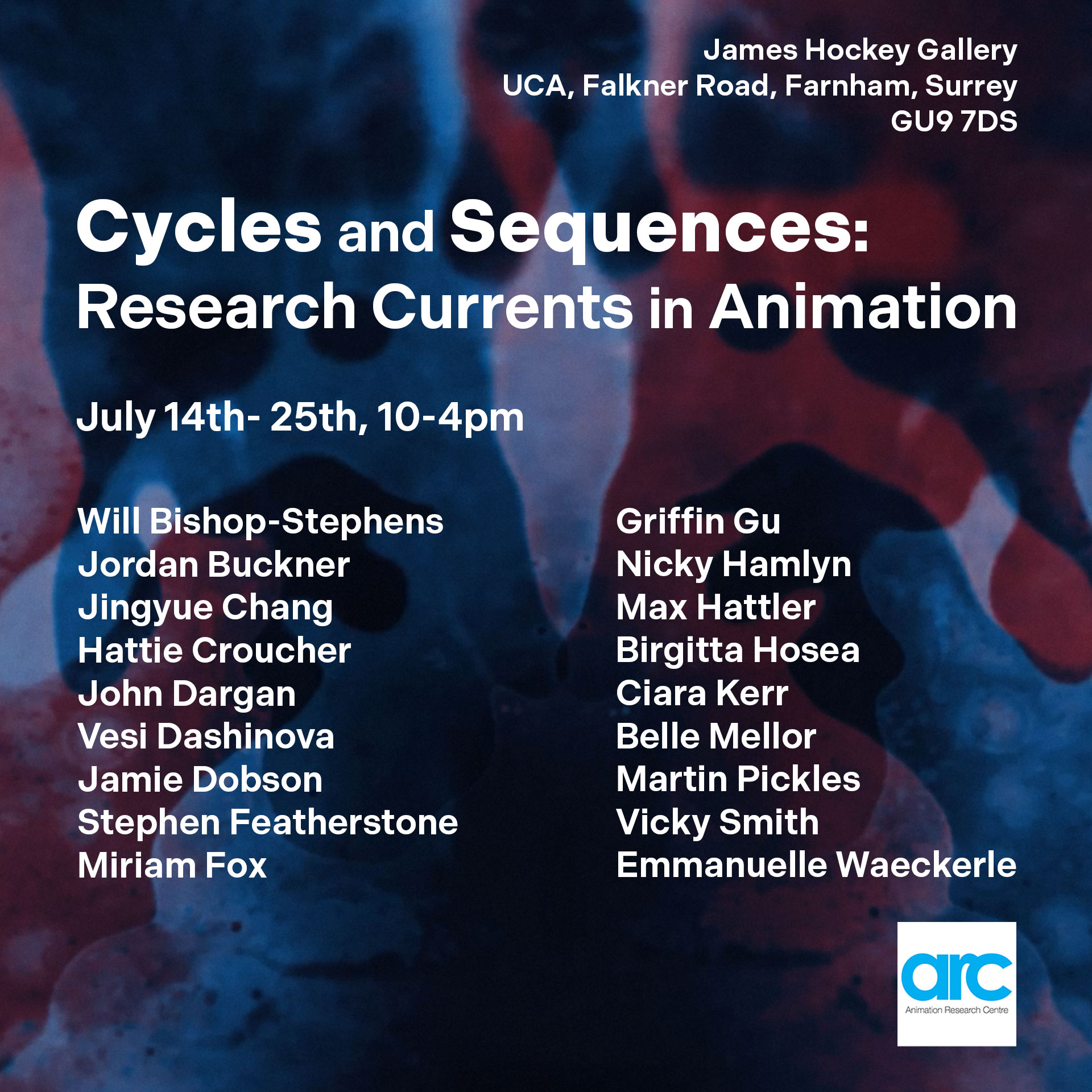
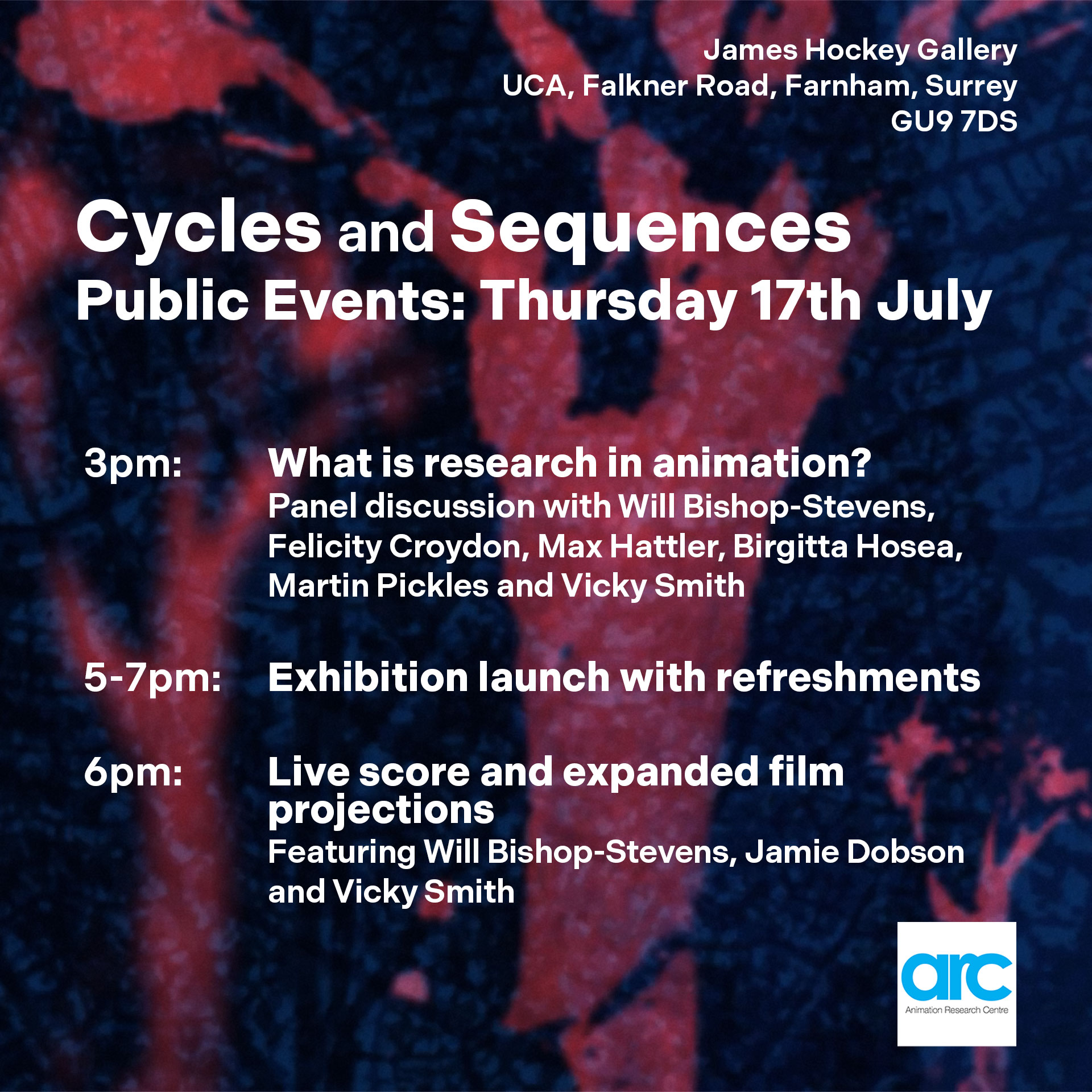
Cycles and Sequences, James Hockey Gallery

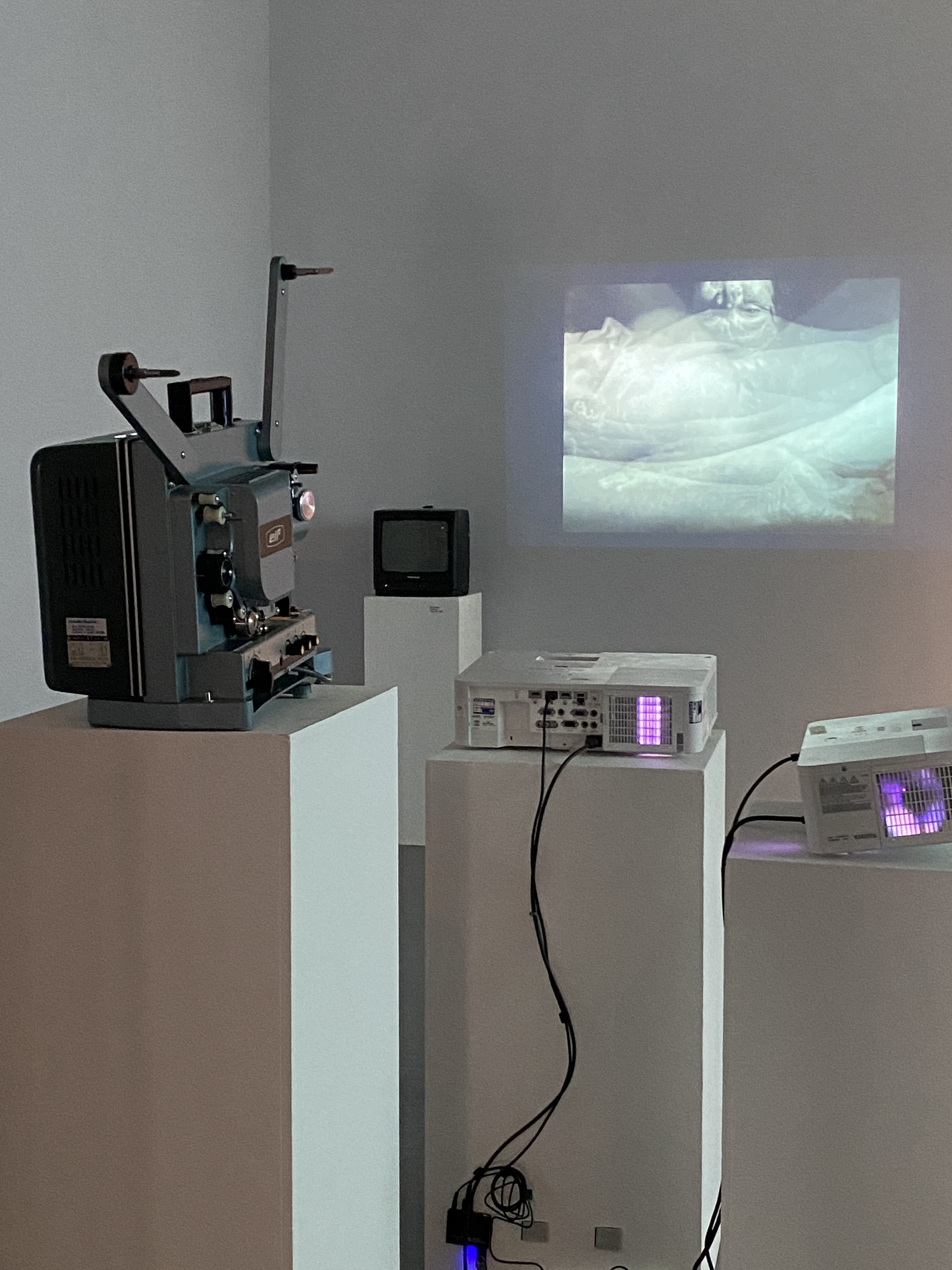
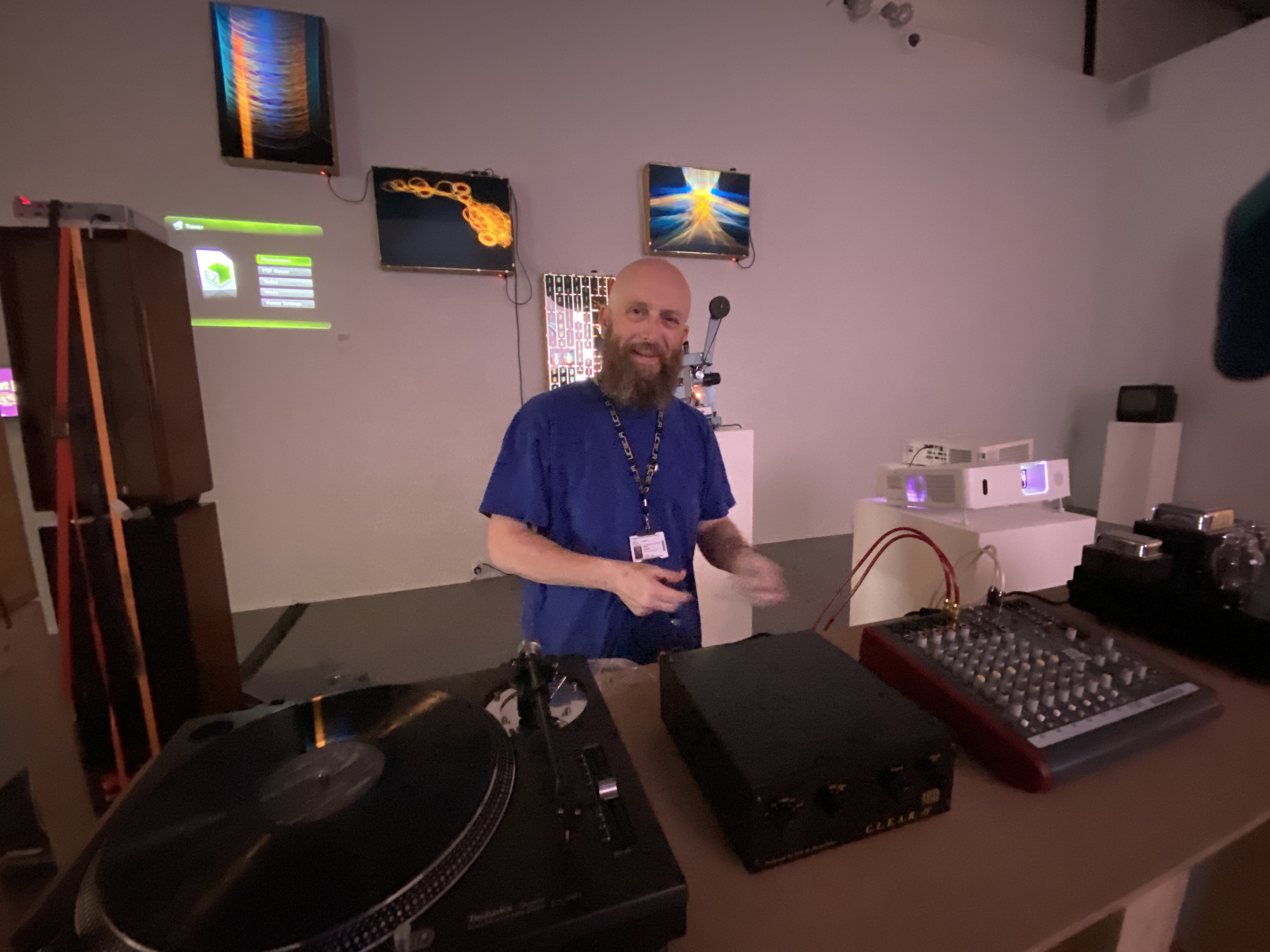
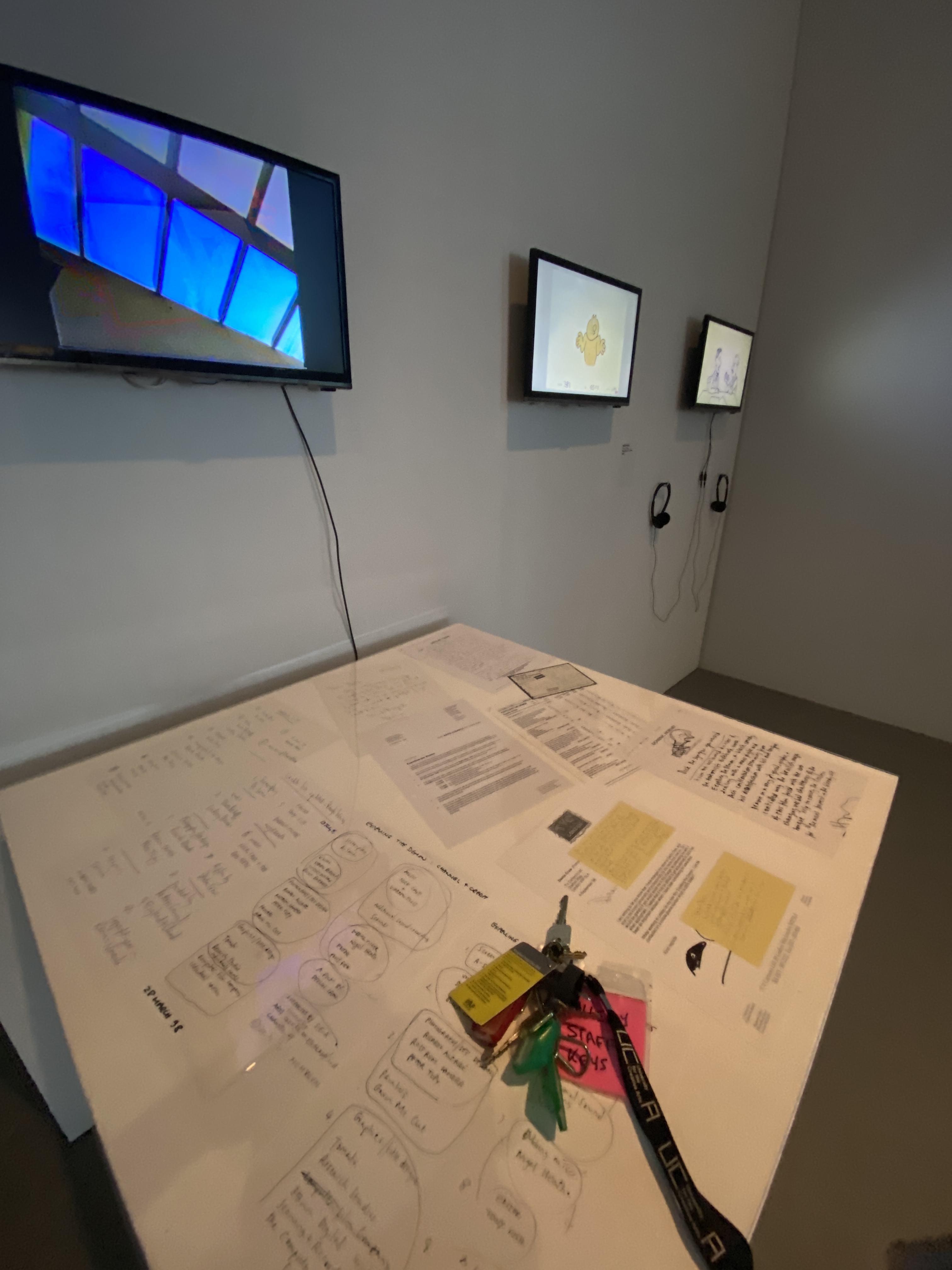
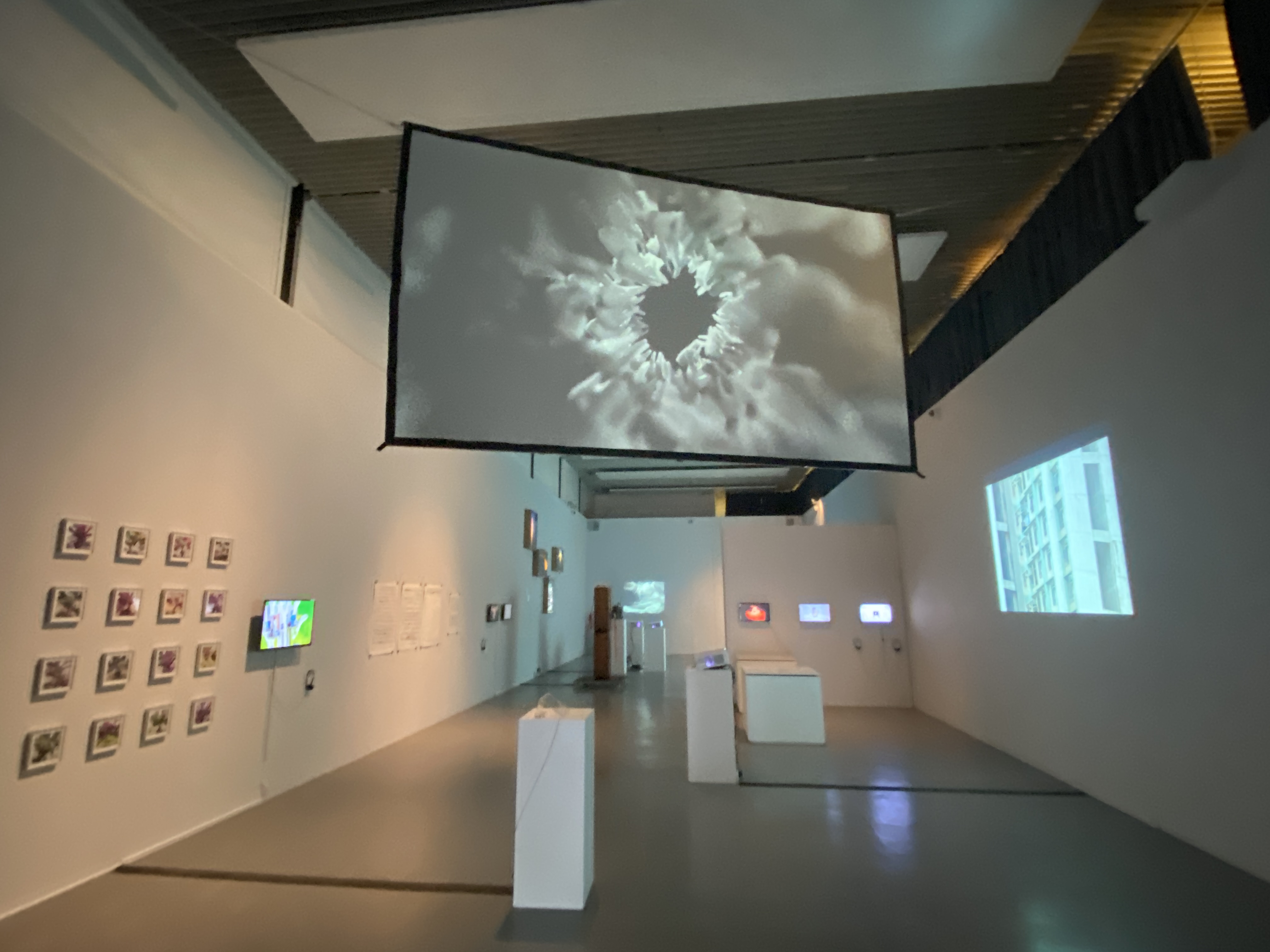
What is the cutting edge of animation? In July 2025, staff and PhD researchers from the Animation Research Centre at UCA came together to present Cycles and Sequences: Research Currents in Animation with interdisciplinary works of expanded animation that span the disciplines of animation, games, photography, design, illustration and music. Alongside installation, sequential drawings, animated documentary, experimental CGI, AI, animation machines and live 16mm performances were items from UCA’s animation archives.

Curated by Vicky Smith, Cycles and Sequences featured more than twenty different artworks on display in the James Hockey Gallery in Farnham along with a number of entirely new collaborations in expanded animation. 

Artists: Will Bishop-Stephens, Jordan Buckner, Jingyue Chang, Hattie Croucher, John Dargan, Vesi Dashinova, Jamie Dobson, Stephen Featherstone, Miriam Fox, Griffin Gu, Nicky Hamlyn, Max Hattler, Birgitta Hosea, Ciara Kerr, Belle Mellor, Martin Pickles, Vicky Smith, Emmanuelle Waeckerle.

The events included live performances and a discussion panel on contemporary animation research featuring Will Bishop-Stephens, Max Hattler, Birgitta Hosea, Irene Kotlarz, Martin Pickles and Vicky Smith.

AP3: Decolonising Animation

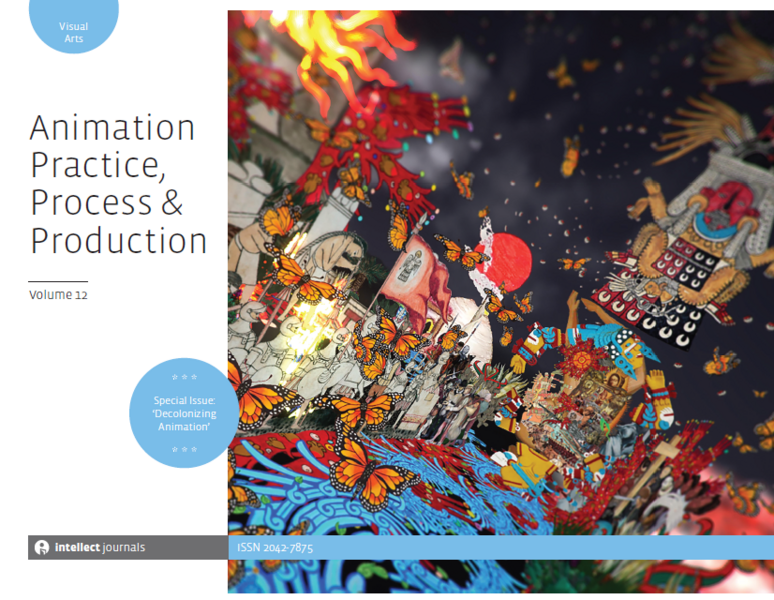
The latest issue of Animation Practice, Process and Production on the theme of Decolonising Animation is now out through Intellect. Co-edited by Birgitta Hosea, Helen Starr, Pedro Serrazina, Natalie Woolf and Tereza Stehlikova with contributions from Diwas Bisht, Paula Callus, Mark Chavez, Ina Conradi, Tara Douglas, Nairy Eivazy, Liliana Conlisk Gallegos, Maybelle Peters, Susan Sloan, Helen Starr and Yijing Wang.

In their editorial article ‘Decolonizing Animation’, Birgitta Hosea and Helen Starr provide an introduction to key ideas from the decolonial thinkers who form the theoretical framework for this issue and how these ideas might enliven the thinking and making of animation.

This edition of the journal is based on the symposium Ecstatic Truth VII: Decolonising Animation, which was held at the University for the Creative Arts in Farnham in 2023. Thanks to all the contributors, the publications team at Intellect, my colleagues at UCA who supported the event and also to the executive editors of the AP3 journal. Cover art courtesy of Liliana Conlisk Gallegos.

To view a live streamed webcast from Thurs 18th May 2023 of all the original presentations at Ecstatic Truth VII: Decolonizing Animationclick here

Ecstatic Truth VII: Decolonising Animation

To view a live streamed webcast from Thurs 18th May of all presentations – click here

Birgitta Hosea, Pedro Serrazina, Helen Starr, Tereza Stehlikova and Natalie Woolf are currently editing a guest edition of the the Animation Practice, Process and Production journal (AP3) for IntellectBooks with written versions of the papers given at this symposium.

09:30 – 19:00 (GMT), 18 May 2023 

 UCA Farnham Campus, Room RG21, Falkner Road, Farnham, Surrey, GU9 7DS

Ecstatic Truth is an annual symposium on animated documentary that takes place in a different country every year. We are interested in what animators and artists have to say about the work they make. This year, in conjunction with the Animation programme, it’s coming to Farnham! We have a different topic every year and this year’s theme is decolonisation. 

What is decolonisation? In a nutshell, it is the idea that it might be possible to ‘unplug from the Matrix’ and find new ways to learn, think and act that are not imposed by dominant power structures. 

How does that apply to animation? Our speakers will look at issues such as how to work collaboratively to tell stories of conflict or underrepresented peoples, how to counter bias in technology and whether animation can be used to express the voice and culture of indigenous peoples. There will be a range of approaches to making animation shown – from traditional drawn animation to the use of VR, AR, game engines, data and motion capture. 

For more info about the schedule and to book: https://www.uca.ac.uk/events/research/ecstatictruthvii/

Farnham is a short train ride of one hour from London. Although there will be industrial action on the rail network 15-20th May, SW Rail trains should have no cancellations, although there may be minor delays.


Call for papers – Ecstatic Truth VII: Decolonising Animation

EXTENDED Submission deadline: Tues 7th March 2023 (midnight)
Symposium details: Thurs 18th May 2023, University for the Creative Arts, Farnham, Surrey, UK 
Submit proposals here via Oxford Abstracts: https://tinyurl.com/mr32u3rj

Keynote:  Liliana Conlisk-Gallegos, The Coyolxauhqui Imperative (VR, 2020)

About Ecstatic Truth

Ecstatic Truth is an annual symposium on animated documentary founded in 2016 that explores issues arising from the interface between notions of animation and of documentary (conceptualised very broadly as non-fiction), with a particular interest in questions raised by experimental and practitioner perspectives. According to Werner Herzog, mere facts constitute an accountant’s reality, but it is the ecstatic truth (a poetic reality) that can capture more faithfully the nuances and depths of human experiences. Given that animation (or manipulated moving image in all of its expanded forms) has the freedom to represent, stylize or reimagine the world, it lends itself well to this aspirational form of documentary filmmaking. This year’s symposium will be held at UCA in Farnham, Surrey and its theme of decolonising animation has been developed in collaboration with our Keynote Speaker, curator, producer and cultural activist, Helen Starr. 

Decolonising Animation 

Foregrounding subjective experience and freed from adherence to the physical, medical and scientific norms of photo-reality, just what is animation capable of? After a disappointing trip to Hollywood in 1930, Sergei Eisenstein travelled to Mexico where he socialised with Frida Kahlo and Diego Rivera, absorbing non-Western ideas from a subaltern culture he very much admired and that clearly influenced his evolving thoughts on animation. In his writing on Disney, Eisenstein considers animation as a subversive form of shapeshifting that resists Western rationalism and binary thinking in its appeal to ancient, evolutionary memories of being formless protoplasm; to the limitless imaginative freedom of childhood and to a joyous return to a state of animism in which all aspects of nature are interconnected. He points out that animated figures squash and stretch with plasmatic elasticity; these unstable forms can change shape, species, gender or any other imposed boundary; can perform impossible tasks or survive death. 

Despite all of its potential, Eisenstein asserts that animated film ultimately lacks consequence and is an escapist, golden daydream: “Disney is a marvellous lullaby for the suffering and unfortunate, the oppressed and deprived.”[1]But could animation be more than escapism and be made to matter? How might animation engage with notions of the human, of possible worlds, of post-, anti- and de-colonialism? 

Coming from an intersectional perspective, this symposium seeks to listen to, unite, engage with and extend notions of opposition to ideologies of colonialism as applied to the practice and analysis of animation. All forms of colonialism, whether settler colonialism, exploitation colonialism, surrogate colonialism or internal colonialism, have one thing in common: the destruction of local and indigenous knowledge systems. Colonialism leaves in its wake extractive, material-based and non-sustainable cultures. How can we articulate and process these complex histories and struggles? Can animation liberate us from internalised empires of the mind? We are interested in debates around form and strategy as well as subject matter. 

Call for Papers

We invite practitioners and theorists working in non-fictional animation to consider the following questions:

  • What happens if we rethink animation as a visioning and performance ritual with the ability for transportation into a poetic reality?
  • What are the implications of animation’s capacity for world building and worlding? Could animation be used to represent non-Western knowledge traditions?
  • As an artform in which the conventional rules of science, space and time cease to function, can animation be used as speculative fabulation to evoke a magical and poetic state that excavates Western anthropocentric worldviews?
  • How can animation and animation studies have a dialogue with the work of post-, anti- and de-colonial theory?
  • What epistemological strategies can be used in animation to interrogate complex histories of injustice and contested land rights?
  • What processes and methods of participatory production and co-design might be used to tell many stories while resisting possibly extractivist/exploitative tendencies of production that may otherwise be prevalent in animation practices?
  • What colonial legacies do the tools and technologies of animation structure into our usage of them? Do the tools and technologies of animation practice reflect the interests of colonial legacies? In what ways might we be vigilant of these in order to question them and imagine technologies that work to counter such interests?
  • How can we rethink reductive notions of ‘primitive thought’ and ‘atavism’, as expressed in historic texts such as that by Eisenstein, and use animation to articulate indigenous knowledge and culture?

Submission Details

We call for papers, presentations and responses on our themes of decolonisation, in all its different manifestations, in relation to non-fiction manipulated moving image and animated documentary, in their most expanded forms. 

Submission is via Oxford Abstracts at this link: https://tinyurl.com/mr32u3rj. You will be prompted to create a free account with Oxford Abstracts.

Your submission should include:

  • Title of your presentation
  • Abstract (brief summary of your proposed presentation) 500 words (including bibliographic references)
  • Short Biography – 200 words
  • Relevant links to moving image work/websites etc.

If the paper is practice-based, it should include reflection and contextualisation in addition to presenting the practice. We will not accept papers that propose to show the practice only.

Finally, we are unable to provide feedback on individual submissions.

Keynote Speakers: Helen Starr and Liliana Conlisk Gallegos

Helen Starr, Founder @ The Mechatronic Library

Helen Starr (TT) is an Afro-Carib curator, producer and cultural activist from Trinidad, WI. She began curating exhibitions with artists such as Susan Hiller, Cindy Sherman and Marcel Duchamp in 1995. Helen founded The Mechatronic Library in 2010, to give marginalised artists access to technologies such as Game Engines, Virtual Reality (VR), Augmented Reality (AR). Helen has worked with many public institutions such as Wysing Art Centre, FACT, Liverpool and QUAD in Derby. Being Indigenous-American Helen is interested in how digital artforms transform our understanding of reality by world-building narratives through storytelling and counter-storytelling. How, by “naming one’s own reality” we can experience the Other. Helen is on the board of QUAD, Derby and on the Computer Animation Jury for Ars Electronica, Linz. In 2020 she developed the concept of a Fluid or DAAD Futurism with Amrita Dhallu and Salma Noor.

Liliana Conlisk-Gallegos

Liliana Conlisk-Gallegos aka. Dr. Machete or Mystic Machete is from the Tijuana-San Diego border region in Southern California. With the goal of advancing the certain decolonial turn, her live, interactive media art production and border rasquache new media art pieces and performances generate culturally specific, collective, technocultural creative spaces of production that reconnect Chicana/o/x “Mestiza” Indigenous wisdom/conocimiento to their ongoing technological and scientific contributions, still “overlooked” through the logic of the decaying Eurocentric project of Modernity. In her Tijuana-San Ysidro transfronteriza (perpetual border crosser) perspective, the current limited perceptions of what research, media, and technology can be are like a yonke (junkyard), from which pieces are upcycled and repurposed to amplify individual and collective expression, community healing, and social justice. She has organized and curated over 14 community-centered, interactive, decolonial, community building, and environmentalist, research-based multimedia artivism and critical intervention performances and her work has been exhibited at ACM|SIGGRAPH, The García Center for the Arts in San Bernardino, Human Resources Art Museum in Los Angeles, the PAMLA Arts Matter of the Pacific Ancient and Modern Language Association, and the Guizhou Provincial Museum in China. Her most recent curation was The Future Past v. Coloniality: Decolonial Media Art Beyond 530 Years, supported by the Digital Arts Community for ACM SIGGRAPH (https://decolonial-media-art.siggraph.org)

She is Associate Professor of Decolonial Media and Communication Studies at CSU San Bernardino and a member of the ACM SIGGRAPH Digital Arts Committee. Her writings have appeared in Critical Storytelling from Global Borderlands: En la línea, Vol. 8, 2022 (Brill Publishers), Re-Activating Critical Thinking amidst Necropolitical Realities: Politics, Theory, Arts and Political Economy for a Radical Change, 2022 (Cambridge Scholars Publishing), A Love Letter to This Bridge Called My Back, 2022 (The University of Arizona Press), Departures in Critical Qualitative Research 3 Vol. 10, 2021 (UC Press), and Journal of Latinos in Education Vol. 20, 2018 (Taylor and Francis).

Organising Committee

This symposium is jointly organised by Professor Birgitta Hosea, Anna de Guia-Eriksson and Nikki Brough, Animation Research Centre, University for the Creative Arts, UK; Helen Starr; Dr Tereza Stehlikova, University of Creative Communication, Czech Republic; Tangible Territory Journal; Dr Pedro Serrazina, Lusófona University of Lisbon, Portugal.

Scientific committee also includes:

Balvinder Mudan, UCA; Dr Will Bishops Stevens, UCA; Jane Cheadle, UCA; Dr Yingying Jiang, BUCT

Contact

All questions about submissions should be emailed to ecstatic.truth.symposium@gmail.com

Ecstatic Truth is supported by: 

[1] Sergei Eisenstein, On Disney, trans. Alan Upchurch (London; New York; Calcutta: Seagull Books, 2017).

Ecstatic Truth VI: To Attend

International symposium in which expanded animation and experimental moving image intersect with documentary, 22nd April 2022, University of Creative Communication, Prague, Czech Republic 

Symposium programme

View the presentations here:

Etymologically “to attend” comes from Middle English (in the sense ‘apply one’s mind or energies to’): from Old French atendre, from Latin attendere, from ad- ‘to’ + tendere ‘stretch’.

At a time when attending an event can mean two things: being present in person or virtually, new questions are raised about what attendance means. If attendance and attention have the same etymological roots, can we consider attending as a form of attention rather than requiring physical presence? And if the essence of attention is its elasticity, can we argue that attention is able to stretch to overcome physical distance? That our shared attention (as well as time and virtual platforms) allows us to be in attendance, together, no matter how physically displaced we are.  

According to philosopher and cognitive scientist Lucas Battich (TT journal 3) shared attention not only helps us learn better, it is also multi-sensory. Is therefore watching a film together more illuminating than watching it alone, in separate spaces? What effect our new, so called “hybrid reality” has on our attention? Which role do the so-called proximity senses play in being attentive, attending to presence?

Attention is a precious and limited human resource which is under pressure: multiple forces constantly fight for our attention. Not just every day demands but social media, advertising and various other inventions of our late capitalist world, which understand that attention and money are intertwined. Attention is what makes us present, attention is learning, attention is the fabric of our experience, attention is being conscious, being conscientious, it is our future memory: we remember what we pay attention to, the rest becomes an unconscious assimilation of facts. And as we know from advertising methods, subliminal messaging can affect us on a level where we are unable to rationalise its effect, hence are more vulnerable.

Film (and moving image) as a medium has long been associated with memory: Like the mind it records and edits, what it deems significant. It can capture moments in time, make them conscious and preserve them for the future. It enables us, the viewers, to attend to the presence of those that came before us, even if they no longer share our everyday reality… Temporal and physical distances are bridged.

In association with Animation Research Centre, University for the Creative Arts, UK; Lusafona University, Portugal and Tangible Territory journal

Synaesthetic Syntax II: Seeing Sound / Hearing Vision

In this second symposium for Expanded Animation at Ars Electronica, we continue our exploration of affect: how animation is felt through sensory information processed by the body. For the second year, this takes a focus on inter-relationships between hearing and seeing.

From the early pioneers, both the audio and the visual components of moving image have been intrinsic to the medium. According to experimental filmmaker Walter Ruttmann (1887-1941), the ‘music of light has always been and will remain the essence of cinema’. Another pioneering avant-garde filmmaker, Germaine Dulac (1882-1942), connected this with movement, ‘cinema and music have this in common: in both movement alone can create emotion by its rhythm and development’.

Our intention with this symposium is to go beyond superficial, formal connections between sound and animated images to think about how the senses are engaged and thus the central role of the body in engaging with perception and experience. Indeed, philosopher, Maurice Merleau Ponty argues that synaesthetic connections –  the cross-wiring between all our senses – is at the root of perception, how we understand the world. In using digital technology we are working with a synaesthetic medium in which all sense perceptions can be codified as inputs and expressed in a common language of zeros and ones that can be fluidly interchanged.

In raising issues about the senses and the body, we are also responding to these peculiar times of pandemic when so much of our interactions have been mediated through a screen rather than through direct experience and physical encounter. We have chosen a range of different speakers who responded to our themes in different ways and I do hope you find all of the talks thought provoking and inspiring.

For more information go to https://expandedanimation.com/#12-09-2021

All talks are archived on the Expanded Animation You Tube channel.

Birgitta Hosea/Juergen Hagler, co-organisers

Ecstatic Truth V: The Age of the Absurd

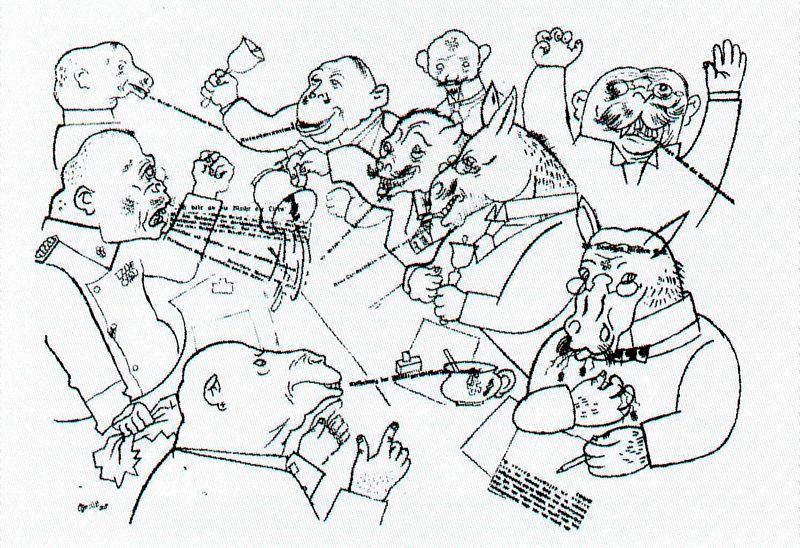
[Image: George Grosz, ‘The Voice of the People is the Voice of God from The Face of the Ruling Class’ (1920)]

Well it has certainly been one crazy year! We planned this symposium to happen in April 2020, but it had to be postponed because of the pandemic. Despite many obstacles, we have decided to go ahead with a series of 3 webinars on Tues 15th – Weds 16th December 2020 in conjunction with our partners Under_the_Radar festival Vienna and the University of the Applied Arts Vienna.

Ecstatic Truth V: The Age of the Absurd

Ecstatic Truth is an annual symposium that explores issues arising from the interface between animation (in all its forms) and documentary (conceptualised very broadly as non-fiction), with a particular interest in the questions raised by experimental and practitioner perspectives. According to Werner Herzog, mere facts constitute an accountant’s reality, but it is the ecstatic truth (a poetic reality) that can capture more faithfully the nuances and depths of human experiences. Given that animation (or manipulated moving image in all of its expanded forms) has the freedom to represent, stylize or reimagine the world, it lends itself well to this aspirational form of documentary filmmaking.

For this, our 5th symposium, held in collaboration with the Under_the_Radar Festival, Vienna, our theme is the Absurd. George Monbiot has described our contemporary age of increasing social and economic inequality, mass extinction and impending climate breakdown as deliberate disaster capitalism in which the ultra-rich benefit as institutions, systems of taxation and democratic processes implode. Everywhere the killer clowns and kleptocrats are taking over, he argues, with ludicrous strongmen dominating nations that would once have laughed them off stage. Absurdity is what they seek in order to take advantage. Chaos becomes the profit multiplier for the disaster capitalism on which they thrive. Every rupture is used to seize more of the assets on which our lives depend.[1]

So how can we imaginatively and creatively respond to these killer clowns and the absurdity of a world being run to continuously make profit regardless of its sustainability? What is there to stand for if the world is perceived as meaningless and how to fight this complacency ? Can we use animation for activism, to re-animate our conscience?  How can we creatively challenge all this doom and gloom, and use our creative practice to navigate and challenge the absurd of our everyday lives? What is the role of humour, surrealism, the historic strategies of the Absurd and Central European Existentialism? Why does animation matter?


[1] George Monbiot, ‘From Trump to Johnson, nationalists are the rise – backed by billionaire oligarchs’, The. Guardian, 26/07/19

Schedule

For more details about the speakers and to watch recordings of the different Webinars: https://2020.under-radar.com/the-age-of-the-absurd.

DAY 1 Tues 15th December

Webinar 1: The Many Forms of Censorship 
19.00 – 20.30 [Central European time]

  • Andrijana Ruzic: Recurring Elements of Absurd in Several Films of Zagreb School of Animation (1958-1969)
  • Gabriella Jutz: Animating Truth(s): Surveillance, Censorship and Journalistic Ethics
  • Susan Young: Who is, or Was, Ms A

Presentations followed by discussion and Q&A hosted by Birgitta Hosea

DAY2 Weds 16th December

Webinar 2: Subversion and Resistance: Defying Oppressive Structures
10.30 – 12.00 [Central European time]

  • Chunning Guo: Rethinking Injustice in the Age of Absurd: Re-Constructing Prisons as Narrative Spaces through Animated Memories
  • Max Hattler: Abstract Animated Documentary? Moving-Image Abstraction and Meaning-Making in Hong Kong’s Age of the Absurd.
  • Zeynep Akcay: Dance, drawing and repetition: an absurd manifesto about female body

Presentations followed by discussion and Q&A hosted by Birgitta Hosea

Webinar 3: Hidden Force: Celebrating the Invisible Labours
19.00 – 20.30 [Central European time]

  • Orla McHardy: x‘C: Maintenance Animation is a drag: it takes all the fucking time’ 
  • Sally Pearce: Shades of Invisibility. A case study in animation activism.
  • Oliver Gingrich / Sara Choudhrey: AYAH – Sign: Collaborative Digital Art with the Grenfell Communities

Presentations followed by discussion and Q&A hosted by Tereza Stehlikova.

Ecstatic Truth is organised by: Birgitta Hosea, Animation Research Centre, UCA Farnham, UK; Pedro Serrazina, Universidade Lusófona, Lisbon, Portugal; Tereza Stehlikova, CREAM, University of Westminster, UK
With thanks to Under_the_Radar: Barnaby Dicker, Martina Tritthart, Holger Lang

Cartoon Animation: Satire and Subversion – presentations online!

All presentations from this one-day symposium that drew upon the legacy of acclaimed animator, Bob Godfrey, to examine the politics of comedy in cartoon animation are now online and publicly available to view free of charge!

Links below

We were also thrilled with this review of the day’s events by Dr Christopher Holliday for the Fantasy Animation blog

Opening Remarks: Tom Lowe / Dr Birgitta Hosea

Keynote 1: Dr Sharon Lockyer, Brunel University London, ‘Contextualizing Comedy Studies’

Panel 1: Performing Satire (whole panel chaired by Professor Paul Ward includes the presentations by Dr Maggie Gray, Pierre Floquet and Kate Jessop plus Q&A)

Dr Maggie Gray, Kingston School of Art, ‘Cartooning and Performance: Cartoon Style Alternative Theatre’

Kate Jessop, University of Brighton, ‘The Politics of Comedy: How has adult animation used satire as a vehicle for feminist cultural commentary’

Pierre Floquet, Bordeaux INP, France, ‘Tex Avery as the Noah Webster of Cartoon’

Panel 2. Absurdity and the Destabilisation of Authority (whole panel chaired by Jim Walker includes presentations by Professor Fran Lloyd, Sarah Tehan and David Wischer plus Q&A)

Sarah Tehan, Belfast School of Art, Ulster University, ‘Captain Phineas May. War Cartoons 1940-1946′

Prof. Fran Lloyd, Kingston School of Art, ‘Humour and the Subversion of Authority. The Animated Internment Drawings of Peter Sachs’

David Wischer, University of Kentucky, USA, ‘Prints in Motion: Amplified Absurdity’

Keynote 2: Steve Bell, The Guardian

Panel 3. Politics and Propaganda from Print to Pixel (whole panel chaired by Dr Birgitta Hosea includes presentations by Professor Paul ward and Dr José L. Valhondo-Crego plus Q&A)

Professor Paul Ward, Arts University Bournemouth, ‘Satire and Subversion in the work of Han Hoogerbrugge’

Dr José L. Valhondo-Crego, Universidad de Extremadura, Spain, ‘Subverting the myths of Francoism in the Spanish satirical press’

Closing Panel

Thanks to the University for the Creative Arts for supporting this event

Animation Research Centre: https://www.uca.ac.uk/research/arc

Synaesthetic Syntax ‘Watch Party’ at IKLEKTIK London

[All of the events from this year’s Expanded Animation strand at Ars Electronica are now available to view online on their You Tube Channel.]

Come together on Sun 13th Sept for a Synaesthetic Syntax ‘Watch Party’ at IKLEKTIK London. At this socially distanced event, a small group of attendees can watch the online symposium from the final day of the Expanded Animation events for Ars Electronica on a big screen together. The presentations explore the interrelationships between audio and animation, between sound and vision. It is hosted by co-organiser Birgitta Hosea of the Animation Research Centre and a few of the UK speakers will be in attendance. This event is supported by the University for the Creative Arts. For more information and to book a free place, go to: https://synaesthetic-syntax-watchparty.eventbrite.co.uk.

Synaesthetic Syntax: Sounding Animation / Visualising Audio is a one-day symposium that brings together animators, musicians, artists, technologists and academics to discuss the interrelationships between audio and animation. Papers cover topics such as synaesthetic connections between sound and image, the role of gesture, improvisation and presence in live performance and the creative use of geometric and algorithmic patterns.

Our Keynote speaker is media artist, Rose Bond, who produces work at the juncture of cinema, animation and experiential design. She will be presenting her latest animated collaboration with the Oregon Symphony Orchestra on a live performance of Luciano Berio’s Sinfonia.

Due to the COVID-19 pandemic, the Ars Electronica festival is mainly taking place online this year with a number of small events taking place at different associated venues around the world. The Expanded Animation strand will have a series of small, socially distanced Watch Parties in Linz, London and Portland.

Synaesthetic Syntax Symposium Schedule:

 10:15–10:45    Keynote: Rose Bond (CA/US), Sounding Together – Choreographing the Unpredictable

11:00–11:05    Welcome: Birgitta Hosea (UK), Juergen Hagler (AT), Harry Whalley (UK)

 11:05–12:40    Panel I: Hearing Colour Seeing Sound
11:05–11:10    Introduction: Birgitta Hosea (UK)
11:10–11:30    Vicky Smith (UK), Expanded Cinema and Para Animation: More than Audio and Visual
11:30–11:50    Alexander Stublic (DE), Presence and interaction in synaesthetic space
11:50–12:10    Sama Mara (UK), A Hidden Order – Revealing connections between geometry and music through harmony and mathematics
12:10–12:40    Panel Discussion (Chaired by Birgitta Hosea)

12:40–14:00    Break            

14:00–15:30    Panel II: In front of your eyes and ears
14:00–14:05    Introduction: Harry Whalley (UK)
14:05–14:25    Giusy Caruso, Bavo Van Kerrebroeck, Pieter Jan Maes (BE), PIANO PHASE for two pianists in VR
14:25–14:45    Umut Eldem (BE), Towards a “Live Synaesthetic Visualisation”? Considerations in Artistically Visualised Sound
14:45–15:05    Jānis Garančs (LV), Algorithmic conflation and re-configuration of audiovisual space and movement in the series of experiments with financial data audio-visualisations as immersive artworks.
15:05–15:30    Panel Discussion (Chaired by Harry Whalley)

15:30–16:00    Break            

16:00–17:30    Panel III: The Kinaesthetics of Music and Vision
16:00–16:05    Introduction: Juergen Hagler (AT)
16:05–16:25    João Pedro Oliveira (US), Gesture Interaction Between Sound and Image
16:25–16:45    Fred Collopy (US), A hypothesis-based approach to visual synthesizer design
16:45–17:05    Eric Dyer (US) Physical Presence and Material Desire: Eric Dyer’s sculptural and performative animation art practice
17:05–17:30    Panel Discussion (Chaired by Juergen Hagler)

17.30-18.00    Closing Note: Rose Bond (CA/US), Birgitta Hosea (UK), Juergen Hagler (AT),

Further information: 

Expanded Animation events at Ars Electronica: www.expandedanimation.com

Animation Research Centre at UCA: https://www.uca.ac.uk/research/arc

Audio Research Cluster at UCA: https://www.audio-research.com

Research Degrees at UCA: https://www.uca.ac.uk/research/research-degrees