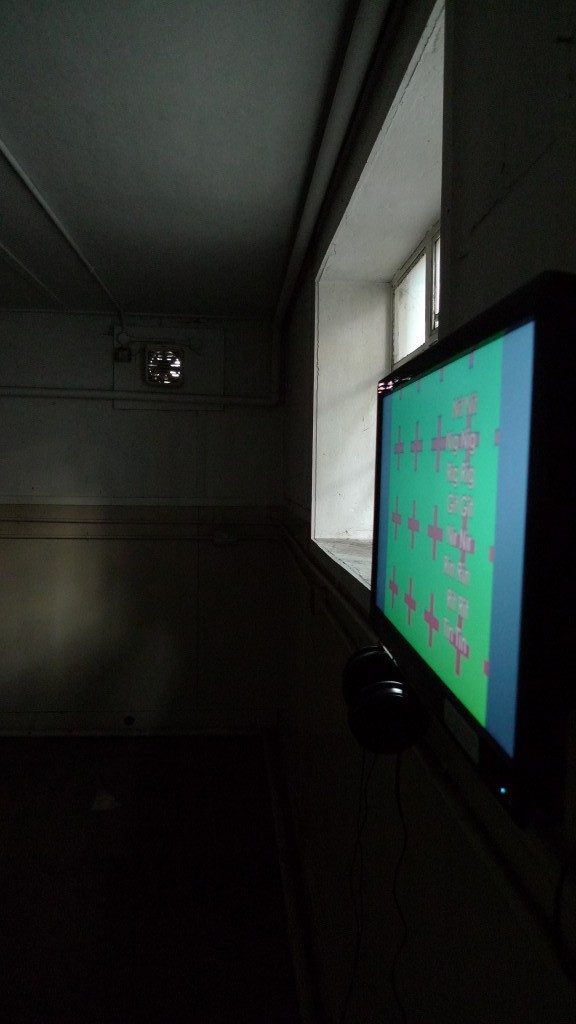
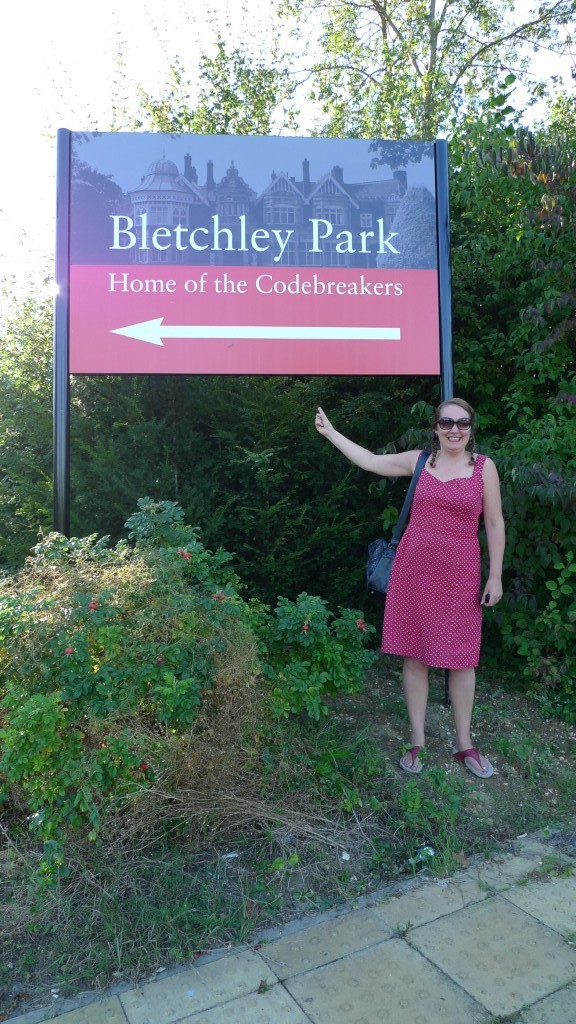
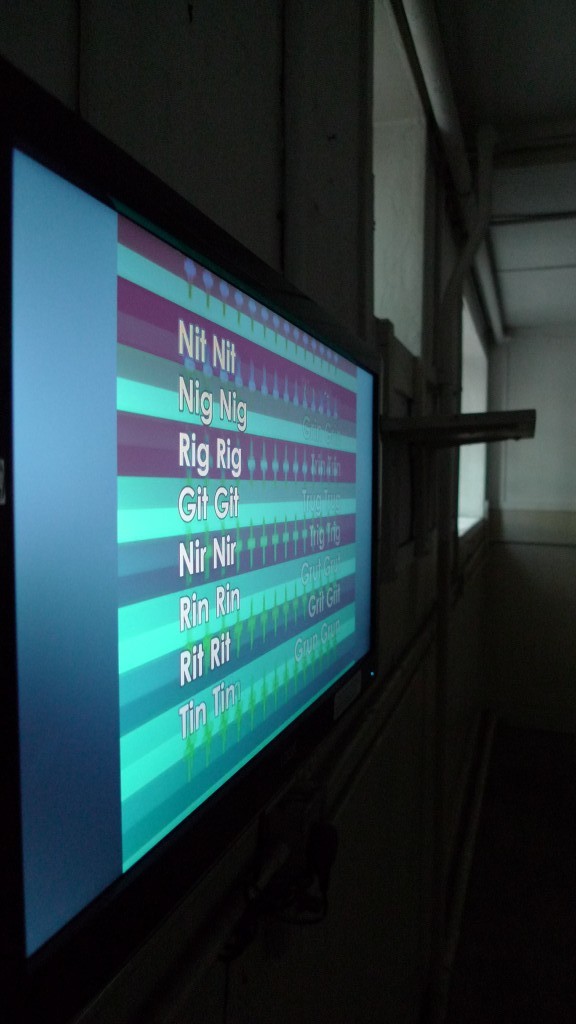
Turple, the film I made about codebreaking with Maryclare Foa earlier this year, is showing in this exhibition in Bletchley Park – home of World War II cryptography in the UK. It is installed in the Bombe Hut, the very room where Alan Turing cracked the Enigma code and set the stage for the modern computer.
This short film was created for the Decode / Recode exhibition, which is in celebration of the 100th anniversary of the birth of Alan Turing and launches the University of Salford’s new MediaCityUk building. Maryclare Foá’s text acknowledges the ongoing influence on contemporary technology by the tortured genius cryptographer, whose sinister demise from a bite into a poisoned apple is memorialised in the Apple Mac logo . Her words explore multiple permutations through which ‘Turing’ may be transformed into ‘Apple’. Birgitta Hosea’s animation is reminiscent of the earliest computer animations by Stan Vanderbeek and Malcolm Le Grice. One of her few forays into the world of coding, the computer generated colours generate the soundtrack through a synthaesthetic algorithm.
The Decode / Recode exhibition is being streamed live over the internet on Friday March 23rd. The live video feed is http://146.87.220.123:554/recode.sdp.
Nenagh Watson is a puppeteer currently researching into what she calls ephemeral animation. She is fascinated by objects that move without human control at the mercy of the elements. Consider the following umbrellas as they are carried by the wind. Their movement is created by natural forces rather than the hands of a puppeteer. Watson uses this motion to inspire works of puppetry:
Observing umbrellas, as well as her earlier work with Polish theatre director Tadeusz Kantor (whom she describes as having said that the umbrella’s metal skeleton explodes like fireworks) inspired Conversations with an Umbrella, a collaboration between Nenagh Watson and sound artist Kaffe Matthews.
Umbrellas, plastic bags, pieces of rope… all discarded items of human debris that fly in the wind or float in the water. From Watson’s Duchampian notion of ‘found’ movement that has been created by chance, she examines moments of tension and freedom, stillness and motion and uses these to inform her work in puppetry. She says her eyes have become opened to the world of random movement around her. For Watson, this is all part of making herself and her presence obsolete in the work, in striving to be without ego.
In her Plastic Bag Labyrinth, shown below, she uses her observation of how air fills discarded carrier bags to create an installation in which the bags are caused to move through the actions of visitors to the installation.
For more information about her working practices, see a review of Nenagh Watson’s Ephemeral Animation workshop at the Central School of Speech and Drama and another account of an earlier workshop.
This post was written in response to her presentation at the Talking Objects Symposium at Loughborough University on 9th March 2012.
Animated projections are used to activate a popular local building, which is falling into disrepair. Developed with the local community, the projections include ideas for how the building could be used in the future.
Strong visual storytelling, iconic, minimalistic design style and faintly disturbing, Motomichi Nakamura is a perfect example of less is more. Here is We Share Our Mother’s Health with music by the Knife (2006).

 Expanded Animation