William Kentridge, I Am Not Me, The Horse is Not Mine

Don’t miss the last chance to see William’s Kentridge’s atmospheric and evocative, multi-screen installation, I Am Not Me, The Horse is Not Mine (2008)  in the Tate Modern Tanks. It finishes on Sunday 20th January.

The title of the piece is inspired by a Russian peasant saying that is used to deny guilt. In Kentridge’s talk about the work on 11/11/12, he related how the animations were created as part of the research process he undertook whilst working on a production of Dmitri Schostakovich’s opera, The Nose, from 1928. This satirical opera is based on Nikolai Gogol’s short story from 1837. Inspired by DADA and a long tradition of the absurd, which Kentridge traces back to Cervantes novel Don Quixote, it did not go down well with the Russian authorities who, according to Kentridge, referred to it as ‘a muddle not music’. Here is a clip with more information about the production.

As Kentridge worked in his studio to develop the production, many eclectic ideas came together for him: the history of the absurd in literature; the Soviet purges of intellectuals; the disembodied nose with a life of its own; the artist’s disembodied sense of judgement in inner dialogue with his intuitive approach to making work; the reconstruction of a coherent self from multiple fractured pieces; Modernism and collage; how we make knowledge from fragments; the amount of visual clues needed before we can recognise a fragment of black paper as a horse; the fragmented nature of the world; his own native South Africa and the fractured gap between the promise of enlightenment which underlies colonialism and the violence, brutality and exploitation that underlies it. It is all of these raw materials and more that have been brought together in the collection of animations that play across the screens in the Tanks.

For Kentridge, the artist’s process of bringing together multiple complex ideas is a metaphor for how we make sense of things. Looking at what is in effect his research and development work, we are presented with a state of becoming, an idea taking shape, but not yet fixed.

‘Medium’ mark II

Medium, a living picture in which I take the role of a techno-medium, channel digital doubles and emanate electronic ectoplasm, will be performed again at two different events in December 2012:

  • Saturday 1st December, Exploding Cinema @ Besides the Screen, St James Hatcham, Goldsmiths College, St. James’s, New Cross, SE14 6AD. This event is on from 6.30-11pm. I will be performing live from 7-9pm. Tickets are £5.
  • December 6th 7th & 8th, GHost IV: Presence and Absence – Haunted Landscapes and Manifesting GhostsSt. John on Bethnal Green, 200 Cambridge Heath Road, E2 9PA (next to Bethnal Green tube).
    Times – December 6th 6.00pm – 9.00pm (I will perform live 6-8pm),
    December 7th 6.00pm – 10.00pm (I will perform live 6-8pm),
    December 8th 2.30pm – 7.30pm (I will perform live 6-7pm).
    This event is free.
Each of these GHost events I appear in are curated by Sarah Sparkes and also feature a host of other artists who do interesting things with moving image and installation. Click on the links for more information.
Here is a one minute excerpt from the first version of Medium, created for the Dickensian Hauntings exhibition curated by Illumini at Shoreditch Town Hall, London, September 2012. I’ll be doing a presentation on this work entitled, ‘The Medium is the Messenger’, at the next Colloquium of Performance Research, 17-18th January 2013, Central School of Speech and Drama, London.
Postscript: Curator, Sarah Sparkes, documented the GHost IV exhibition on her blog and also on Flickr.

Call for Papers: Animation / Graphic Novel Research Student Symposium, Saturday 23rd March 2013

Call for Papers: Animation / Graphic Novel Research Student Symposium, Central Saint Martins College of Art and Design, University of the Arts London, Saturday 23rd March 2013

The Centre for Performance at Central Saint Martins warmly invites research students to submit proposals for the fourth animation PGR* research symposium, which will be extended for the first time to the field of graphic novels. The symposium is designed for MPhil / PhD students to present their work-in-progress to a friendly and well-informed audience of peers and supervisors.

Proposals on the topic of animation or graphic novels should be for either:

–       a 20 minute conference paper (to be followed by 10 minutes of discussion);

–       or an alternative discussion/presentation format as appropriate for practice-based research.

Send your proposals to Dr Birgitta Hosea <b.hosea@csm.arts.ac.uk>. Closing date 31st January 2013.

*The Animation Postgraduate Research Group was set up in 2011 by Dr Paul Ward of the Arts University College at Bournemouth as a safe and supportive network in which MPhil/PhD students can exchange ideas and disseminate their research. To join the group and receive further information about this and future events, contact <pward@aucb.ac.uk>.

The Centre for Performance at Central Saint Martins brings together MA Character Animation, BA/MA Performance Design & Practice and Drama Centre London to offer a range of approaches to performance that are embodied, live, recorded, virtual or animated.

On Shadowgraphy and Shadow Puppets

In the first week of MA Character Animation one of the activities that we do is a workshop on Shadow Puppets. Further to the work of historic and contemporary artists that I showed my students in class, I am posting some more clips for them here. The workshop is an opportunity to talk about the ancient puppetry techniques that have contributed to contemporary animation as well as to work in teams to create work that is spontaneous, immediate and relies on strong silhouettes. I enjoy the traces of artifice that result from having to work rapidly to produce something in one day – reflections of the room on the screen, the glimpses of hands and wires.

Although we look at examples of creating caricatures with bare hands from the Victorian music hall, usually my students don’t take up the suggestion to incorporate their own bodies in the shadow worlds they create. Hand shadowgraphy seems to be particularly well developed in India, for example this promotional video for tourism in Kolkata, Let Calcutta Surprise You:

In their live show, Shadowland, dance company, Gruppe Pilobuscombine the physical presence of the live body with objects to create dynamic shadow plays .

For more information check out the website of Gruppe Pilobus.

Here is the full version of Miwa Matrayek’s Dreaming of Lucid Living, in which Matrayek’s backprojected shadow is combined with black and white animation in a live performance.

Spring Heeled Jane, a recent film from Richard Mansfield’s Mucky Puppets in 2012, used a filmed version of shadow puppets.

Spring-Heeled Jane 2015 from Mansfield Dark on Vimeo.

I have previously posted clips of Ben Hibon’s work (see here). In his animation for Harry Potter and the Deathly Hallows, you can see the influence of shadow puppet aesthetics to inform computer generated animation. Another short film in this vein is The Mysterious Explorations of Jasper Morello directed in Australia by Anthony Lucas in 2005 and nominated for an Oscar.

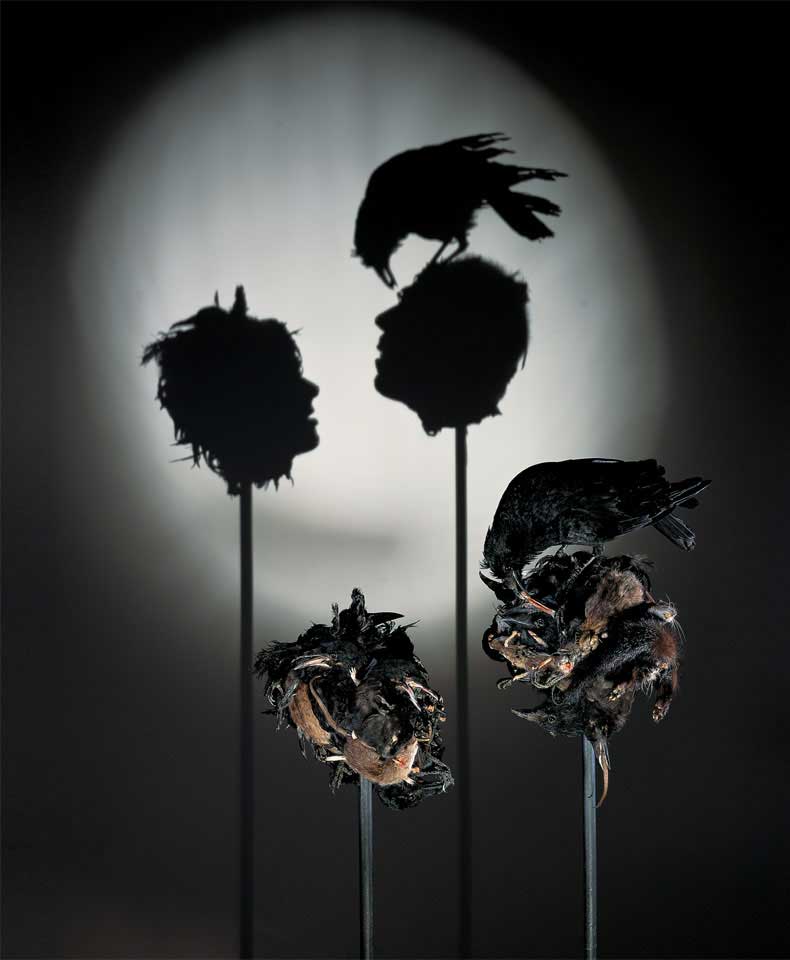
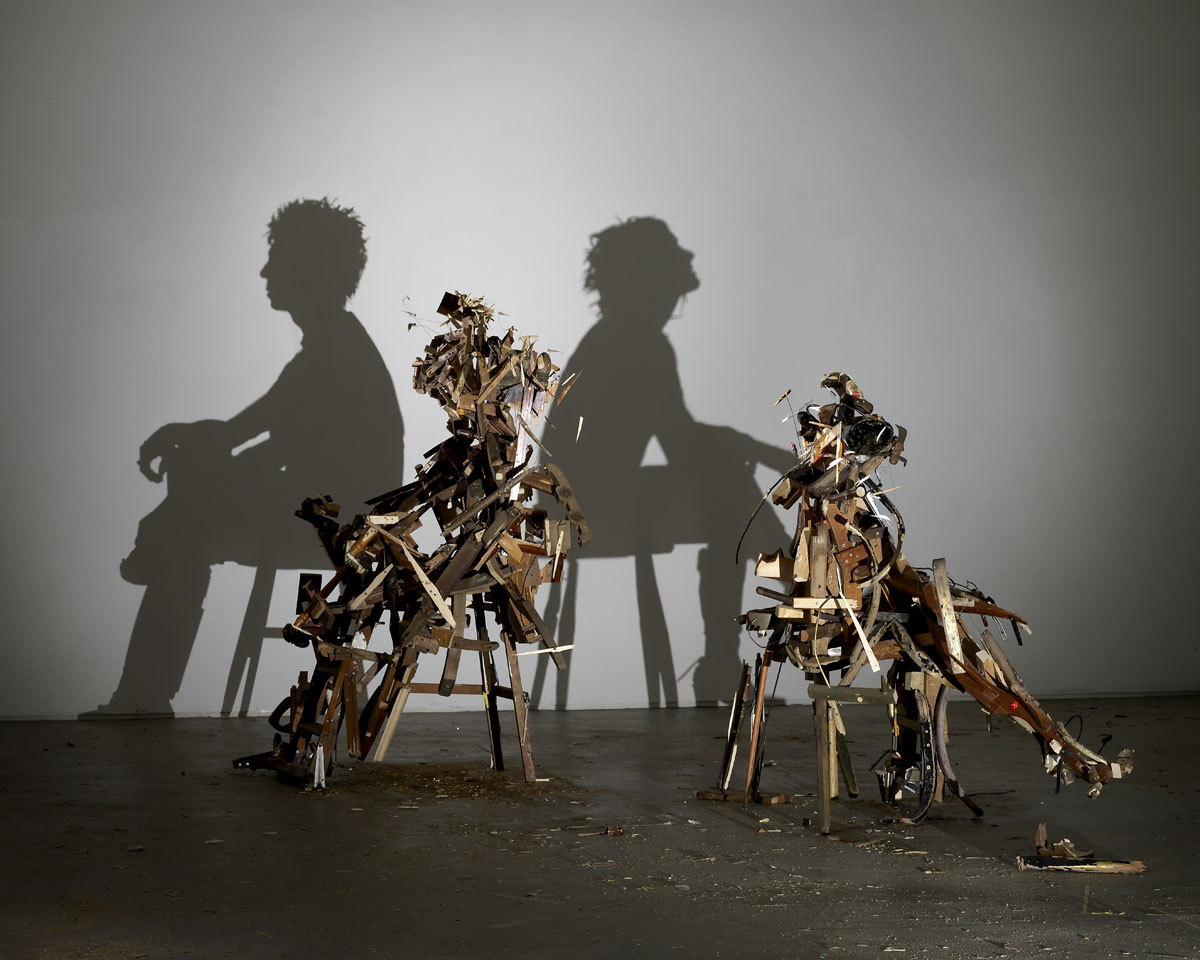
It reminds me of the work of Tim Noble and Sue Webster, who create sculptures which are all about the shadows. More about their work here on their website.


Tim Noble / Sue Webster, Wild Mood Swings, 2009-10


Tim Noble / Sue Webster, Kiss of Death, 2003

Jim Walker sent me a great example of a live sword dance performer combined with shadow images – Taichi Saotome in a Special New Year Performance of Dragon and Peony from the Galaxy Theatre, Tokyo in 2011.


Medium

“The cinema is the art of ghosts, a battle of phantoms… it’s the art of allowing ghosts to come back.” Jacques Derrida

Inspired by Victorian spirit photographs, this tableau vivant explores the act of mediation that is involved in the digital image making process. Taking the role of a techno-medium, I channel messages from film and radio through my multiple digital doubles and live projections of automatic writing, electronic ectoplasmic drawing and animation in an examination of the connections between a medium, such as film or digital code, through which a message is encoded, stored and transmitted and the psychic medium, a person who transmits messages from the spirit world.

Photos typical of the materialising mediums who inspired this work:


Medium by Birgitta Hosea,
Shown as part of the Dickensian Hauntings Illumini Event,
27th September – 4th October 2012.
Open daily from 11-7pm (free).
Opening Night on Thursday 27th September from 6pm – 10pm
Late Night Openings: Sat 29th Sept & Thurs 4th Oct till 10pm
At Shoreditch Town Hall, 380 Old Street, London EC1V 9LT

Medium will be performed live at the following times (a video installation will play at all other times.):
Thursday 27th: 6-6.45, 7-7.45, 8-8.45
Saturday 29th: 6-6.45, 8-8.45
Saturday 29th: 7.30-7.45 Artist’s talk in which I will show examples of the original Victorian spirit photographs that inspired the project.
Thursday 4th: 6-6.45, 7-7.45


Preview presentation at Hostings 9:  Presence – ghost-makers 2
Wednesday September  26thth at 6.30pm – 9.00pm
The Hostings are a night of presentations and performances exploring the desire to materialise what is absent by manifesting ghosts.
At this event, I will present the research into Victorian spirit photography and materialising mediums that inspired the work.

The talks are FREE but please email:
ghost.hostings@gmail.com
to reserve your seats.

Venue: The Senate Room, First Floor, South Block, University of London, WC1E 7HU (An apparition known as ‘The Blue Lady’ has been reported to haunt the Senate room)

Hostings 9 Programme

Birgitta Hosea: Medium
Rosie Ward: Artful Hauntings: How Artistic Intuition can Create New memories within Landscape
Guy Edmonds:  Seancé du Cinema – A synthesis of domestic resurrection media

GHost is a visual arts and creative research project which brings together artists, writers, academics, scientists, curators, researchers and others for workshops, so-called Hostings and exhibitions and screenings of moving image art. The Hostings have been taking place in the “haunted” rooms at Senate House, University of London and the exhibition have been hosted annually by St Johns on Bethnal Green and also by The London Art Fair and Folkestone Triennial.

More information: www.host-a-ghost.blogspot.com


Derrida interviewed in Ghost Dance (dir. Ken McMullen, 1983, UK / West Germany, Channel 4 Films):

https://youtu.be/WG_JA6SJD8k

Heart of Glass

At the recent Society for Animation Studies conference at RMIT in Melbourne, I was fascinated to discover the glass-mation work of Mark Eliott and Jack McGrath. In their presentation they described how a glass artist met an animator and their own distinctive brand of stop-motion was born. Created in collaboration with Vanessa White, Dr Mermaid and the Abovemarine was created frame-by-frame  in painstaking detail with molten glass and then digitally composited. It tells a tale of a marine biologist who can talk to fish.

'Dr Mermaid and the Abovemarine' from Jack McGrath on Vimeo.

Here are some beautiful Experiments in Living Glass made by Eliott and McGrath.

Glass animation: Experiments in living glass #1 from Jack McGrath on Vimeo.

With the rich, tactile surfaces that they create, the work goes beyond the audiovisual and invites the viewer to want to reach out and touch it. For them, this materiality is evident in the work of Agnieszka Woznicka, whose film Birdy (2008) engages with a delight in surface texture. Part of the pleasure of watching her film lies in the details of the feathers, bark and moss – all beautifully presented.

Birdy from Agnieszka Woznicka on Vimeo.

Eliot and McGrath were also inspired by Karel Zeman’s 1948 film, Inspirace. This short film about a glass artist’s daydream starts inside a drop of water and features dancing ice skaters and penguins made of glass.

Another source of inspiration was the Pes film, Western Spaghetti (2008), in which familiar objects are used in unconventional contexts that changes their everyday meaning.

Nathalie Djurberg’s World of Glass was the first time that I had seen an installation that combined stop motion and glass. A new exhibition in Australia has just finished, which featured the work of a total of seven Australian artists combining glass and animation. From the 6th June to the 14th July, Deakin University Art Gallery in Melbourne held a Glassimations exhibition featuring the work of Eliot and McGrath as well as Tom Moore, Deirdre Feeney, Lee Whitemore, Lienors Torre and Alistair Boell who have all created a combination of animation and installations made of glass.

The catalogue (ISBN 978-0-9806214-9-5) features essays about glass as material and glass as philosophical metaphor. Here is a blog featuring some more glass animation work from some of the artists included.

Adobe Creative Week 2012

Want to know more about the latest versions of Adobe software – CS6? Then get involved in the UK’s first ever Creative Week, which starts on Monday 9th July.

Click here [http://www.adobecreate.co.uk/creativeweek] to join Adobe and a series of invited speakers for lively interactive debates, creative challenges and exclusive demonstrations broadcast live online over 5 days from their London studio.

Every aspect of the creative industry will be covered with the help of creative luminaries, industry experts, Adobe evangelists and many members of the creative community – including yours truly on Wednesday 11th July at 14.30 when I will be demonstrating the new 3D Ray Traced Render Engine in After Effects CS6! My student on MA Character Animation, Adriano Vessichelli, will also be participating in the Video Challenge on the same day.

Busby Berkeley

Feeling fruity? Busby Berkeley is an amazing source of inspiration for composition on screen and ideas for how to cut from one series of shapes to another. Here is an example of Berkeley’s visual choreography featuring the fantastic Miss Carmen Miranda in ‘The Lady With the Tutti Frutti Hat’ from the 1943 technicolour musical extravaganza, The Gang’s All Here from 1943.

This film is seriously bizarre. Consider the ending of the film which manages to go from children waltzing in polka dot dresses to hula hoops to disembodied heads!

In this clip from the opening of the Gold Diggers of 1937, there is an example of his style of baroque choreography in which the human form is abstracted into pure pattern. He must have been very influenced by modernist painting and early abstract animations.

Berkeley alienates the female form. His work removes all sense of the individual or personal and presents his dancers as dehumanised shapes of collective flesh that are completely under his control. His style was completely dependent on the high budgets of Hollywood escapism and the cheap labour of depression era dancers. To my modern eyes, his work is beautiful and yet permeated with a whiff of fascism.

By A Waterfall sequence from Footlight Parade, 1933.

8th China International Cartoon and Animation Festival

CICAF is the biggest animation festival in China and includes the Golden Monkey King Animation Awards, an education summit, animation trade fair, project investment fair, masterclasses, conferences and Cosplay shows.

The tourist destination Hangzhou is beautifully located at the side of a large lake and is rapidly becoming an important city for animation with the regional government investing 70 million yuan (approx £7million) to support original animation projects in the last year. 22 major roads in the city are decorated with cartoon characters. The city is also preparing to open an amazing new Comic and Animation Museum designed by Dutch architecture firm MVRDV, which will be made in the form of cartoon bubbles and include an IMAX cinema. This museum will definitely be worth visiting when it’s completed. Here is the architectural visualisation.

I felt very privileged to be selected by the British Council to participate in the Expo as part of a UK Day. The opening ceremony for the festival was unlike anything I have ever seen before. We were taken to the Huanglong Sports Stadium, which is bigger than Wembley, to see a truly incredible show. After opening speeches from government officials on the cultural and economic significance of the animation industry, the Golden Monkey Awards were presented to festival prize winners. We were then treated to a two-hour spectacle, which featured kites, flying acrobats, mass dance troupes in all kind of costumes, ice skaters, Chinese popstars and TV presenters. Two massive screens on either side of the auditorium relayed live video feeds of the action. Huge screens also played animations that served as backdrops. Local dignitaries were seated in special seats at the front. Everyone was given plastic hand clappers with flashing LED lights so that the applause was magnified. I cannot imagine anything on this scale to launch a UK animation festival!

The scale of the expo itself was simply staggering. There were two halls in the convention centre, each the size of Olympia, but standing three stories high. On each of the three days we were there the number of people who attended the show exceeded 100,000 people. The demographic was mainly teenagers to early 20s and some families with their children.  As it was a public holiday, this seemed to be a major attraction for teenage comic and animation fans. The only event I could compare it with would be Comic Con in the USA.

I spoke to a lot of people, but the majority simply wanted their photos taken with me as there are not many foreign visitors to Hangzhou.

One of the most fascinating aspects of the trip was my introduction to the world of Cosplay. In this teenage sub-cult, costumes are worn that make the wearer look like a character from a (Japanese) comic or animation. I was fascinated by the extent to which animation could influence fashion and the sheer scale of the economics behind this.

Not only was there a Cosplay competition, but several halls of clothes and accessories. I couldn’t resist buying myself a leopard print pair of ears with bells. At times I was surrounded by elves, cat people, French maids, pirates and purple haired ancient warriors with animal ears.  I can imagine Chairman Mao turning in his grave!


On the final day of our trip, the British Council had arranged some cultural visits for us. In the morning we went to the Zhongnan Animation company. Founded in 2004 by the CEO of a construction company who wanted to see Chinese animations made for his children, the company now has over 300 staff. In the short time since it was founded, it has produced over 15 TV series and 25 feature films.

We were treated to a screening in their 4d cinema – as well as wearing 3d glasses you sit in a chair that moves with the motion of the action in the animation and air is puffed past your face at certain times. In addition, we were taken to see their merchandising store. Most of the profit in animation comes from toys and other associated items for which the animation itself serves as an advertisement. We were shown a number of new interactive toys that were being developed.


China is a clearly emerging as a force to be reckoned with in the field of animation. The animation industry is not only very successful in China economically, but also has cultural significance for the government who are keen to promote the development of Chinese art forms.